Sunday, October 18, 2015

International Archaeology Day

On October 17, the world celebrated International Archaeology Day. It was a day to help spread interest in what archaeology is and what archaeologists do to the public. To celebrate, MSA members along with CSI and the QAR Conservation lab were invited by NOAA's Monitor National Marine Sanctuary to the OBX Seafood Festival in Nags Head. The public outreach event reached about three hundred people and shared our love of archaeology with the public. The event allowed us to explain what underwater archaeology is, the different technologies behind it, and create interest among kids in pursuing history and archaeology. Special thanks to Monitor's Kara David and Will Sassarossi for organizing the event and inviting us down. Also, a shout out to Dr. Nathan Richards for allowing us to stay at his house, so we could make it to the event.

MSA members Lauren Christian, Katie Clevenger and Bettie Pratt sharing our program with some interested people.

Dr. Nathan Richards explaining side scan sonar images to the public. 

Wednesday, September 30, 2015

Fall Field Schools

This last month, our second years split up to conduct research in the fall field schools. One group, under the guidance of Dr. Bradley Rodgers and DSO Mark Keusenkothen, traveled to Wisconsin to conduct a phase II pre-disturbance survey on Fleetwing. Fleetwing is a schooner built in Manitowoc, Wisconsin in 1867. The group--Katie Clevenger, Lauren Christian, Kelsey Dywer, Mitch Freitas, Victoria Kiefer, and Sydney Swierenga--documented five pieces of the wreck to compare them to previous mapping done on the site. While there, the students also got to explore the stunning country side of Wisconsin and shipwreck trials established by the state.
Swierenga recording a section of Fleetwing

Garrett Bay

The second field school stayed in North Carolina and explored three different sites in different creeks off of the Pamlico River. The students--Elise Carroll, Jim Kinsella, Patrick Merrigan, Bettie Pratt, Allyson Ropp, Sara Spatafore, and Devin Urban--split into three groups each taking a creek. Under the guidance of Dr. David Stewart, each site was recorded as best they could be in the black muddy waters of the Pamlico. The sites included a logging containment area, a centerboard schooner, and a flat bottom vessel. While the students were limited by the conditions of the Pamlico River area, they practiced different techniques of recording and surveying, such as side scan sonar, and dealt with sites many did not know of.
Dr. Stewart driving the boat

Students watching sonar feed, looking for potential targets

Scenic view of Blounts Creek


Sunday, August 30, 2015

River Float

To close out the first week events, MSA hosted a float down the Tar River. All were welcome to come and slowly drift down the Tar River. Over the afternoon, we relaxed and joked around before fully breaking into the semester. Thanks to Dr. Bradley Rodgers for towing us to our end point!


Friday, August 28, 2015

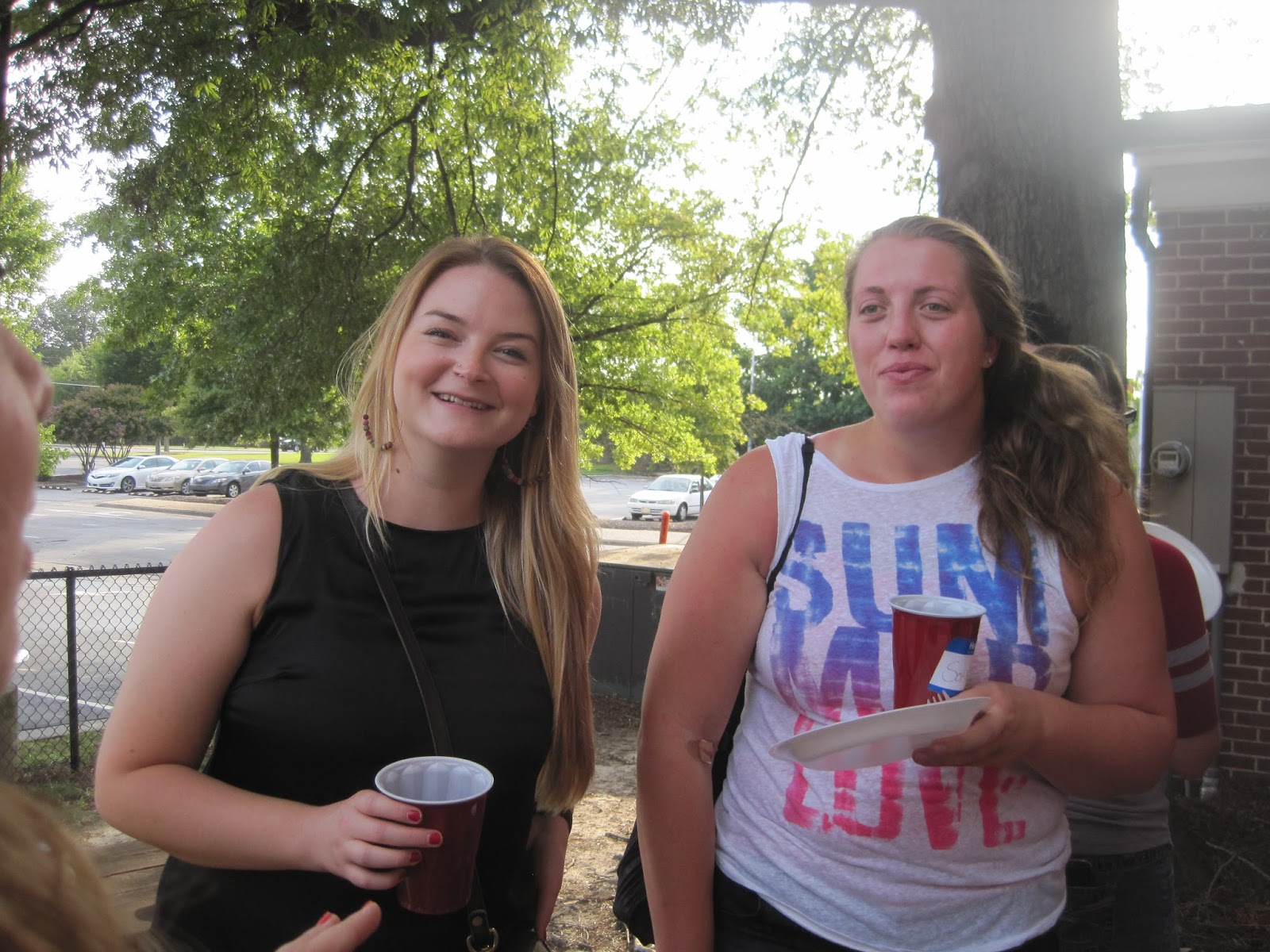
Welcome Aboard

After surviving the first week of school, MSA hosted the Welcome Aboard Party to welcome in the new first year students. This opportunity allowed the new students to meet those returning as well as professors; the Dean of the Graduate School, Dr. Paul Gemperline; and the conservators from the Queen Anne's Revenge Conservation Lab, Sarah Watkins-Kenney, Courtney Page, and Kimberly Kenyon. The party provided the opportunity to relax from the first week of school and a fun and inviting environment to make useful contacts and discuss potential work. Thanks to everyone at Eller, Emily Schwalbe, and Elise Carroll for hosting us!


Tuesday, June 23, 2015

Costa Rica Field School

For the past month, our first year students along with their professors, Dr. Lynn Harris and Dr. Nathan Richards, and crew chiefs Jeremy Borrelli, Hannah Piner, and Melissa Price participated in summer field school in Costa Rica. The team was there to document two wreck sites in Cahuita National Park, Cahuita, Costa Rica. One site was made up a 13 different cannon and two anchors, which were all mapped into place. The other site was a brick pile that stretched about 50 meters and two cannon. These ships may be two Danish slave ships burned and wrecked by the crew who missed their target location in the Caribbean Islands. A third site was mapped and examined in Puerto Viejo, El Lanchon. This site represents a barge used in constructing the Panama Canal and was left in Costa Rica following its use.
Besides documenting the sites, the students photographed maritime art work throughout Cahuita and Puerto Viejo to see how maritime society infiltrates societal values and lifestyle. They also had the opportunity to document small boats, in particular the unique fishing boats of the community, including the boats used for diving.
To finish the project, students and crew chiefs presented the findings of the project to the community and to students at a local high school. They also wrote up a report upon returning to the States.
Read more about the project at the project's blog: http://blog.ecu.edu/sites/hist5530/, and look forward to a session at SHA in Washington DC this year focusing on our adventures in Costa Rica.

The students would like to thank the professors and crew chiefs for putting up with us and teaching us about the numerous steps to completing a full project. We would also like to thanks Jason Nunn for accompanying us as our DSO.
Brick site

Cannon site

El Lanchon

Local Maritime artwork

Students working hard mapping the brick site

Friday, May 29, 2015

Scientific Diving and Field School Prep

Over the last few weeks since the semester ended, our members have been participating and leading training exercises in scientific diving to help the first years finish their check out dives and get ready for the field season in Costa Rica. We conducted the scientific diving check out dives at Fantasy Lake, a quarry northeast of Raleigh, along with two wreck sites, Indra and USS Pickett. Through these dives, our first years learned search and navigation techniques as well as finished training for dry suit, full face mask, and nitrox.

These dives led up to our first years preparing for field school this summer in Costa Rica. Through the past week, the field schoolers along with our crew chiefs-Hannah Piner, Melissa Price, and Jeremy Borelli-participated in lectures, hands-on learning activities, and snorkeling practice to prepare for the numerous tasks that field school will hold. More stories and pictures about field school will come as the project wraps up in a few weeks. If you would like to follow in the meantime, please follow the Costa Rica Field School blog at http://blog.ecu.edu/sites/hist5530/. Wish us luck as our members and students embark on a unique experience into Costa Rica.


Sunday, May 3, 2015

Craw-fish Boil...Yum!!

On Saturday, MSA hosted their first craw-fish boil. Taking place as the semester is ending, the gathering allowed current students and facility along with alumni to come together, enjoy the spring weather, and eat tons of craw-fish. The craw-fish were accompanied by other delectable Cajun fare to help fuel our students for their final exams. The event also marked the end of this years activities hosted by MSA.

We would like to give our thanks to the McKinnons, who graciously welcomed us to their home to eat as well as providing the equipment and space to cook such great food. We would also like to thank Katie Clevenger and Nathan King for taking the time to plan and orchestrate the event (well mainly the cooking). Thanks for coming out!!